
 Upload Script
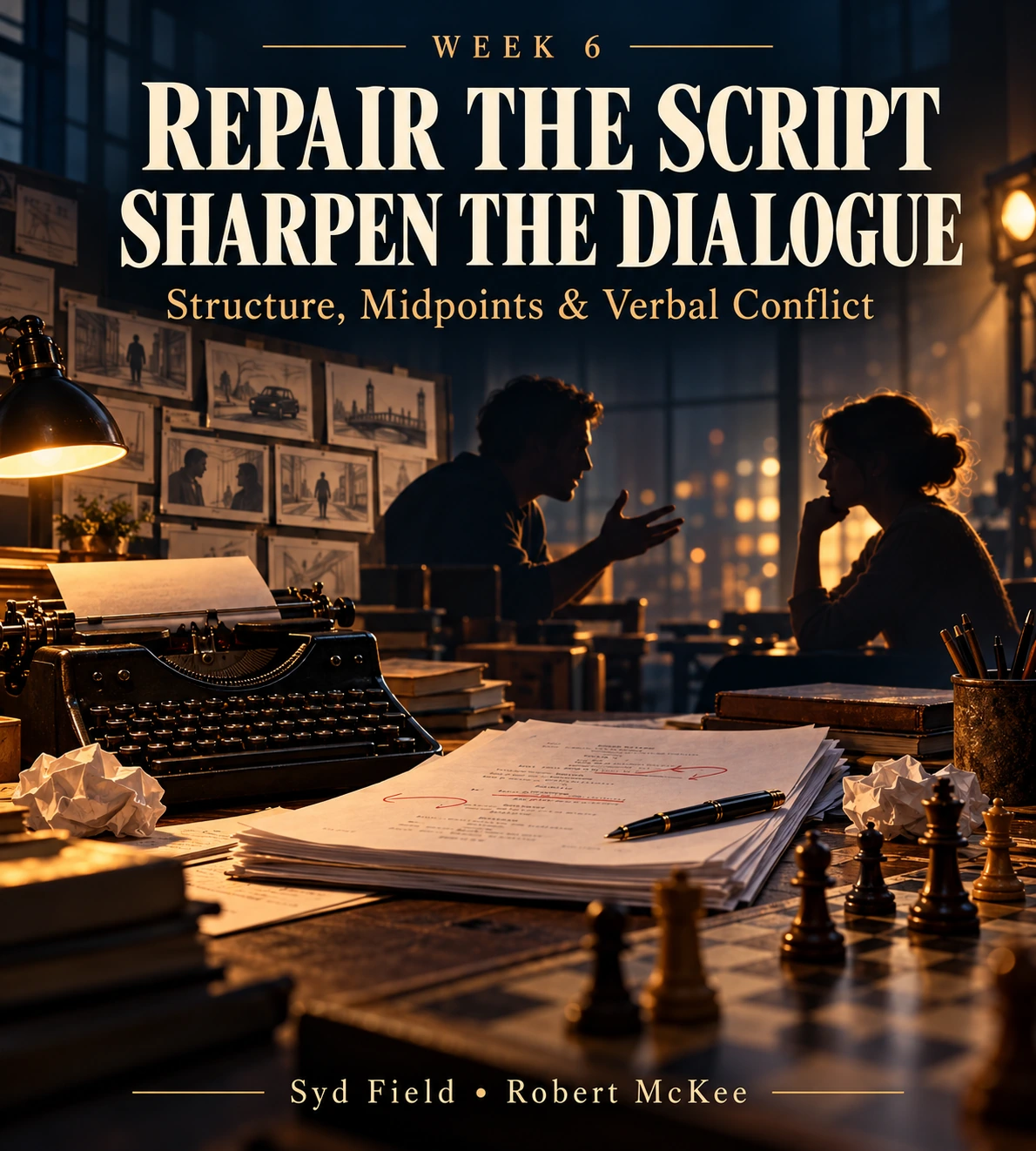
After weeks of drowning in macro-structure, act design, and full-script blueprints, this week zooms all the way down to the atomic unit of screenwriting: the individual scene. Up until now, the focus has been on mapping out sixty-page deserts and landing clean midpoints. This week forces us to put a single scene under a microscope, examining how to construct it, edit out the fluff, and write dialogue that hides what characters are actually thinking. But while Field approaches the page like someone with a pair of hedge trimmers trying to hack away dead weight, McKee treats every single beat of dialogue like an active psychological war zone.
Syd Field on Scene Purpose and Narrative Momentum
To give Syd Field some credit, he finally stopped giving broad, vague lectures and actually handed over a few practical editing tools you can use when a draft starts feeling sluggish. In Screenplay, he defines a scene by two strict metrics: place and time. Every time you change location or jump the clock, you are in a new scene. He insists that every scene must serve one of two non-negotiable functions: it either advances the plot or it reveals character information. If it does not do at least one of those things, it is just dead weight. In The Screenwriter's Workbook, his section on writing the second scene tackles that awkward slump right after a big opening hook, showing how to build immediate context and keep narrative momentum rolling before the audience checks out.
Enter Late and Leave Early to Improve Scene Pacing
Where Field really delivered, though, was in The Screenwriter's Problem Solver. In Sceneus Interruptus, he diagnoses scenes that stall out and die halfway through, pointing out that a scene almost always collapses the second characters lose a clear, active goal or when the immediate conflict evaporates. Then, in Enter Late, Leave Early, he offers arguably his most practical piece of advice across all his books: cut out all the useless dramatic throat-clearing around the core action. You jump into a scene at the absolute last possible second before the confrontation happens, and you exit the exact moment the emotional shift or information exchange takes place. Instead of watching characters drive up to a house, park, walk to the porch, knock, sit down, and exchange polite small talk before finally arguing, you start the scene right in the middle of the screaming match and cut away before they even say goodbye. It is a simple trick, but it genuinely fixes dragging pacing without feeling like one of his usual page-counting gimmicks.
Robert McKee on Scene Design and Beat Analysis
Value Turning Points and Shifts in Character Power
McKee, of course, operates on a completely different plane by turning the exact same topic into a deep dive into human behavior. In Story, his chapter on scene design reminds us that a scene is not just two people talking in a room; it is a self-contained mini-story that must feature a definitive value turning point. If a scene starts with a character feeling hopeful and ends with them feeling equally hopeful, nothing actually happened, and the scene is just dead air. A scene only works if there is a sharp gap between what the character expects to happen when they take an action and what reality throws back in their face. In Scene Analysis, he gives a step-by-step audit to break writing down into beats—the smallest units of behavioral action and reaction—allowing you to trace how power and emotional dominance shift line by line between characters.
Text and Subtext in Dialogue Reveal Hidden Character Motives
The absolute highlight of the week was McKee's chapter on text versus subtext in Dialogue. McKee argues that real life is lived almost entirely in subtext. Text is merely the surface level: the literal words a character speaks and the physical actions they perform. Subtext is the hidden reality underneath: what they are actually thinking, feeling, desiring, or actively suppressing. McKee warns that if your text matches your subtext—meaning your characters sit around explicitly stating their inner feelings and describing their own psychology out loud—your script becomes flat, on-the-nose, and unbearable to read. Human beings rarely say what they mean, especially when the emotional stakes are high. Real drama lives in that quiet, uncomfortable space between what is spoken and what is deliberately left unsaid, where characters use surface dialogue as a shield or a weapon to disguise their true motives.
Week 7 Verdict on Combining Scene Editing and Subtext
While Field gave us a sharp pair of shears to chop out boring scene intros and keep the narrative moving at a respectable clip, McKee was the one showing how to write characters complex enough to make a scene worth reading in the first place. Between Field’s practical cutting rules and McKee’s psychological breakdown of subtext, it made for a surprisingly solid, substance-heavy week.