
 Upload Script
Syd Field’s Practical Tools for Repairing a Screenplay
After spending weeks rolling my eyes at Syd Field obsessing over exact page counts, something unexpected happened this week: I actually got on board with his material. He finally dropped the vague, hand-waving lectures and handed over real, working diagnostic tools for when a script starts careening off a cliff.
Sequences and Flashbacks and the Midpoint in Act Two
Looking at his book Screenplay, the chapter on building sequences completely reframes the terrifying, endless void of Act II. Instead of staring down sixty blank pages of existential dread, you get to chop that wasteland up into bite-sized, goal-driven chunks, basically treating each stretch as its own self-contained mini-story glued together by a single concrete objective. Then over in The Screenwriter's Workbook, the breakdown on time and memory was surprisingly refreshing. His guardrails for handling flashbacks actually make narrative sense: past events have to actively crank up the present dramatic tension instead of just functioning as a lazy, momentum-killing dump of exposition. But his absolute best cure for the classic second-act slump is finding the midpoint. Dropping a massive, irreversible turning point right in the dead center around page sixty acts like an anchor. It instantly splits a meandering plot in half, turning a sluggish stretch where the protagonist is just passively reacting into an aggressive second half where they finally go on the offensive.
Diagnosing Dull Scenes and Missing Story Elements
Where Field really earned his keep, though, was in The Screenwriter's Problem Solver. The chapter on the nature of dullness cuts straight through the fluff to explain why scenes fall flat, pinpointing that a scene usually dies the second a character loses their clear, immediate want. The section on tracking down what is missing works like a proper diagnostic checklist to find dropped setups or absent emotional beats that leave viewers scratching their heads. Meanwhile, his tactic of shifting to another time or place shows how simply changing the physical environment or jumping the clock can jumpstart a flatlining plot by throwing characters totally off balance. For once, his advice felt like genuine, practical wrench-work rather than a cash-grab rehash of old ideas.
A Week Without Blake Snyder’s Beat Sheet Approach
I completely skipped Blake Snyder this week, and honestly, a tiny part of me missed that unhinged, high-octane Hollywood energy. In the middle of working through Field's meticulous structural repairs, I almost wanted Blake to kick the door open, slam an index card onto a corkboard, and tell me exactly which plot beat to swap out to fix a sluggish scene.
Robert McKee on Dialogue and Psychological Conflict
Balanced Conflict Between Equally Matched Characters
McKee, on the other hand, was operating on a totally different wavelength by digging into dialogue. Rather than worrying about macro architecture, he zeroed straight into the psychological wiring and the raw mechanics of verbal warfare. In his breakdown of balanced conflict, he dissects what happens when two characters of equal intellect and stubbornness collide. Because neither person can easily bulldoze the other, the conversation transforms into a tense, high-stakes chess match where every single line is a calculated maneuver to seize leverage.
Comic Conflict Through Mental Rigidity and Self Deception
His chapter on comic conflict was easily the highlight of the week. McKee argues that genuine comedy does not come from goofy circumstances or cheap visual gags, but from pure, unyielding mental rigidity. Comedic characters are so completely blinded by their own fixations and delusions that they are structurally incapable of evolving under pressure. Their dialogue is hilarious because it continuously highlights their total lack of self-awareness, showing them aggressively weaponizing language just to defend their own absurdity. They use words as shields for their own self-deception, which sounds like an absolute blast to write.
Week 6 Verdict on Combining Structure and Dialogue
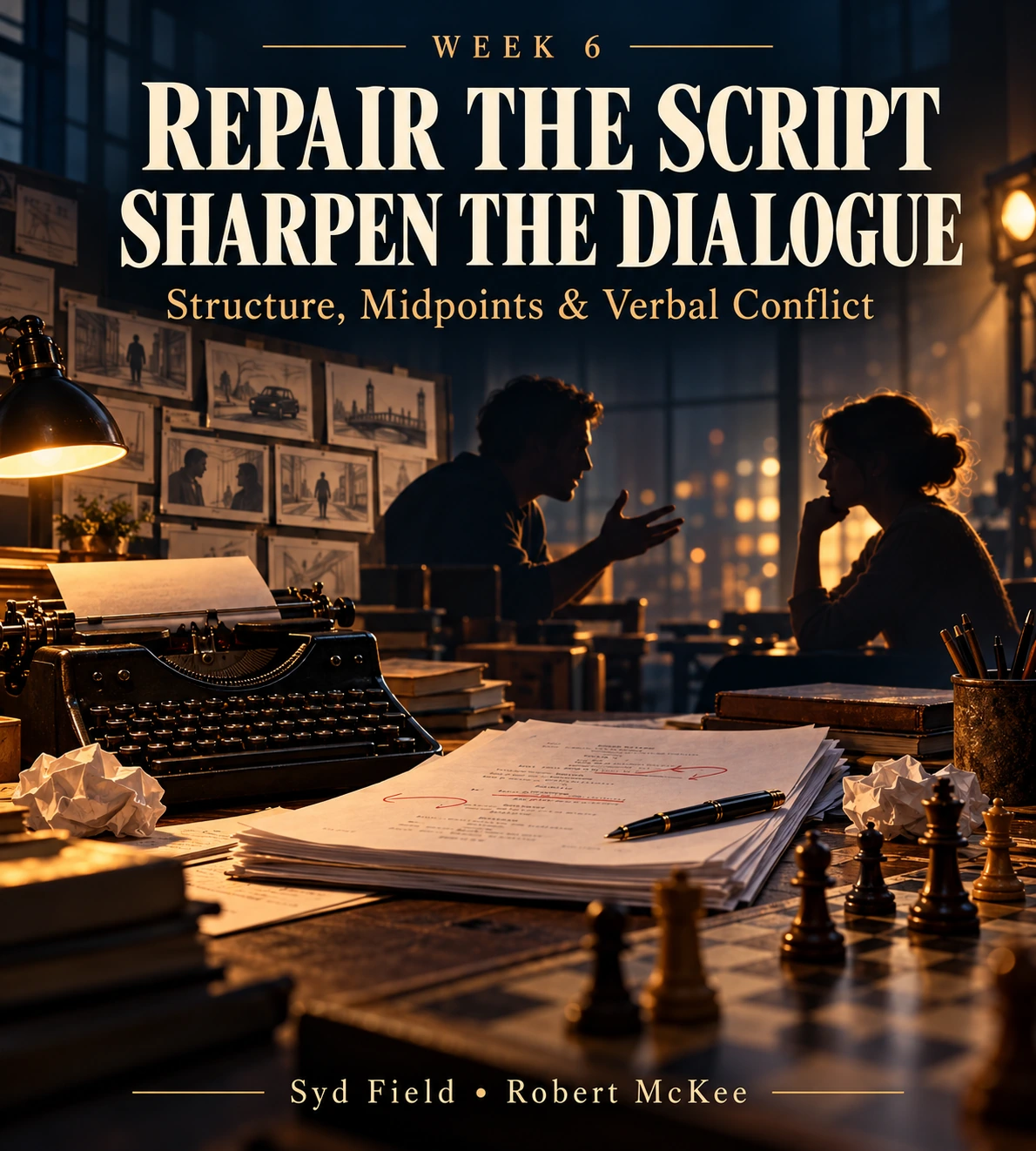
Field gave us a practical toolkit to diagnose broken scenes and anchor the middle of a script, while McKee showed us how to craft dialogue sharp enough to keep people glued to the page. Combining Field's structural engineering with McKee's psychological conflict made this easily the most genuinely useful week yet.