
 Upload Script
Week 9 brings us straight to the end of the line: third-act climaxes, resolutions, active protagonists, and the crushing forces of antagonism that make or break a finished draft. After spending weeks building narrative engines and fine-tuning dialogue beats, this round forces all three theorists to answer the ultimate craft question: how do you bring this entire chaotic machine to an explosive, satisfying landing without the script caving in under its own weight?
Robert McKee on Antagonism and Escalating Story Conflict
Robert McKee delivers what might be his sharpest material yet in Story with the principle of antagonism. His core argument is simple: a protagonist and their journey are only ever as compelling as the obstacles blocking their path. If your opposing force is weak or generic, your hero automatically turns into a dull cardboard cutout. He maps antagonism across an escalating spectrum, starting with the simple opposite of a core value, pushing into its active contradiction, and culminating in the negation of the negation—the absolute dark, corrupted extreme of your theme. It drives home the reality that conflict is not just an antagonist waving a gun around, but an inescapable psychological pressure cooker.
Crisis and Climax and Resolution Through Character Choice
In crisis, climax, and resolution, he sketches the ultimate emotional peak. To McKee, the crisis is that brutal crossroad where a character is backed into choosing between two irreconcilable evils or two competing goods, and the climax is the decisive explosion triggered by that impossible choice. The ending feels like an inevitable psychological consequence rather than a tidy outline requirement.
Syd Field on Active Protagonists and Third Act Momentum
Syd Field holds his ground surprisingly well here by targeting protagonist agency and third-act momentum. Pulling from Screenplay, The Screenwriter's Workbook, and The Screenwriter's Problem Solver, he goes after the most common killer of final acts: passive heroes and unearned resolutions. In his breakdown of passive versus active writing, he calls out that frustrating type of draft where the main character just drifts through scenes, letting side characters solve every problem and do all the heavy lifting. Field demands that the moment you cross Plot Point II into the final act, the protagonist must grab the wheel entirely and drive the narrative straight into the climax through sheer willpower.
Planning the Ending to Build an Earned Resolution
In his chapters on endings, he doubles down on his classic rule that you need to know your destination before you even type page one. It is standard Field handholding, but after watching so many third acts run out of gas, his insistence on building a direct, active runway to the finish line feels genuinely useful.
Blake Snyder on Story Logic in Save the Cat
Then, right on cue, Blake Snyder kicks the door open with the immutable laws of screenplay physics from Save the Cat. After taking a breather from his hyper-commercial style, diving back into his unhinged rulebook was an absolute breath of fresh air. Snyder drops his signature industry tests, starting with Double Mumbo Jumbo, his warning that audiences will only buy one single leap of faith per script, meaning you cannot mix vampires with alien invasions.
Exposition and Personal Stakes and Character Transformation
He tears into over-complicated exposition with Lay the Pipe, warns that involving news reporters or the media instantly kills personal tension in Keep the Press Out, and uses the Covenant of the Arc to remind writers that if a character does not undergo a radical transformation by the final pages, the story is dead in the water. It is classic, aggressive Hollywood triage, and it works wonders for cutting out narrative bloat.
Week 9 Verdict on Combining Structure and Conflict and Story Logic
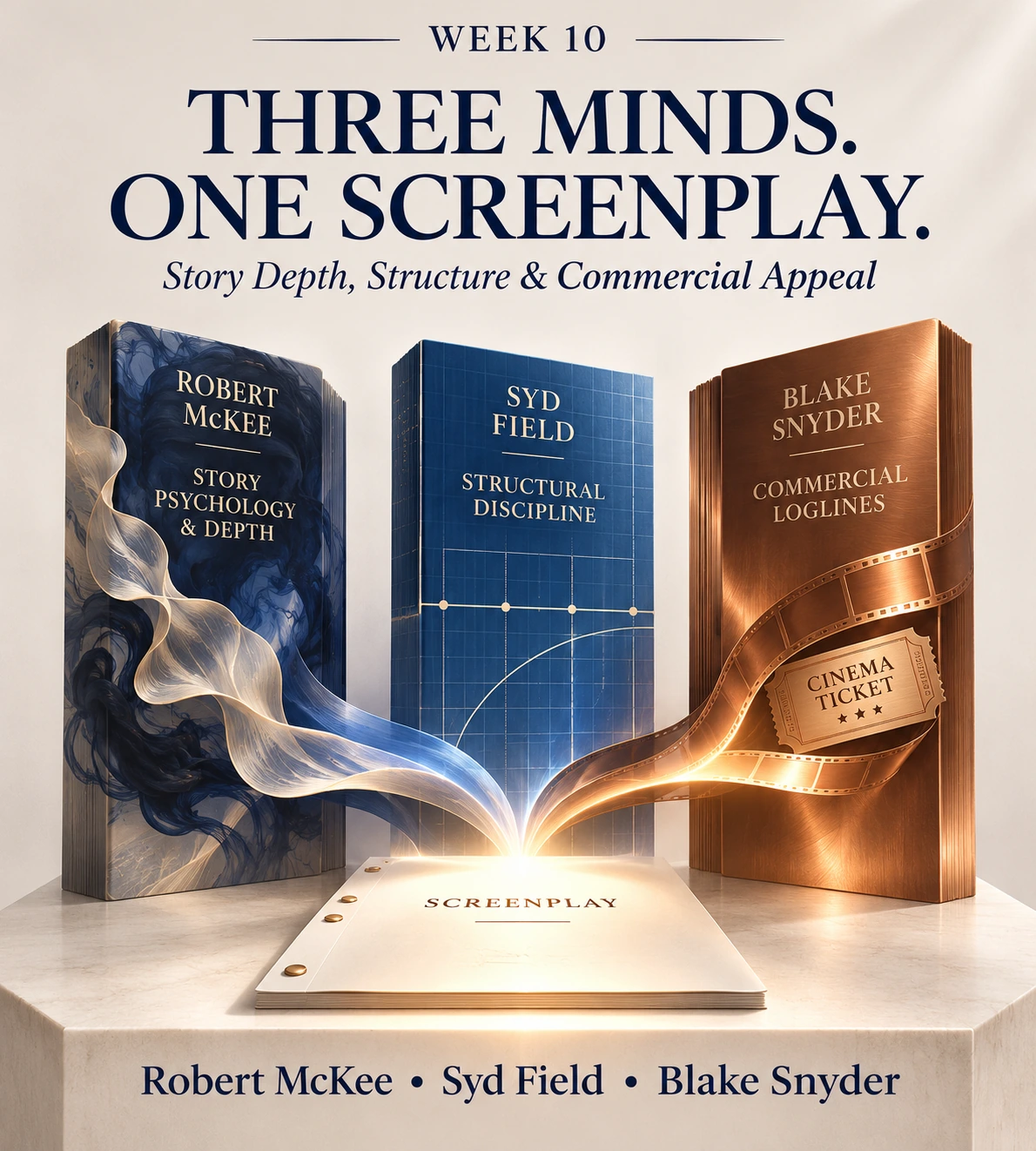
What made this material click so well is how cleanly all three angles fit together. Field brings the structural discipline to keep the hero driving the action toward a concrete finish line. McKee provides the psychological depth to ensure the villain carries genuine weight and the climax lands like an emotional bomb. And Snyder shows up with a bucket of ice water to make sure you keep the rules of your world clean, focused, and free of nonsense. It makes for easily one of the most rewarding weeks of the entire lineup.