
 Upload Script
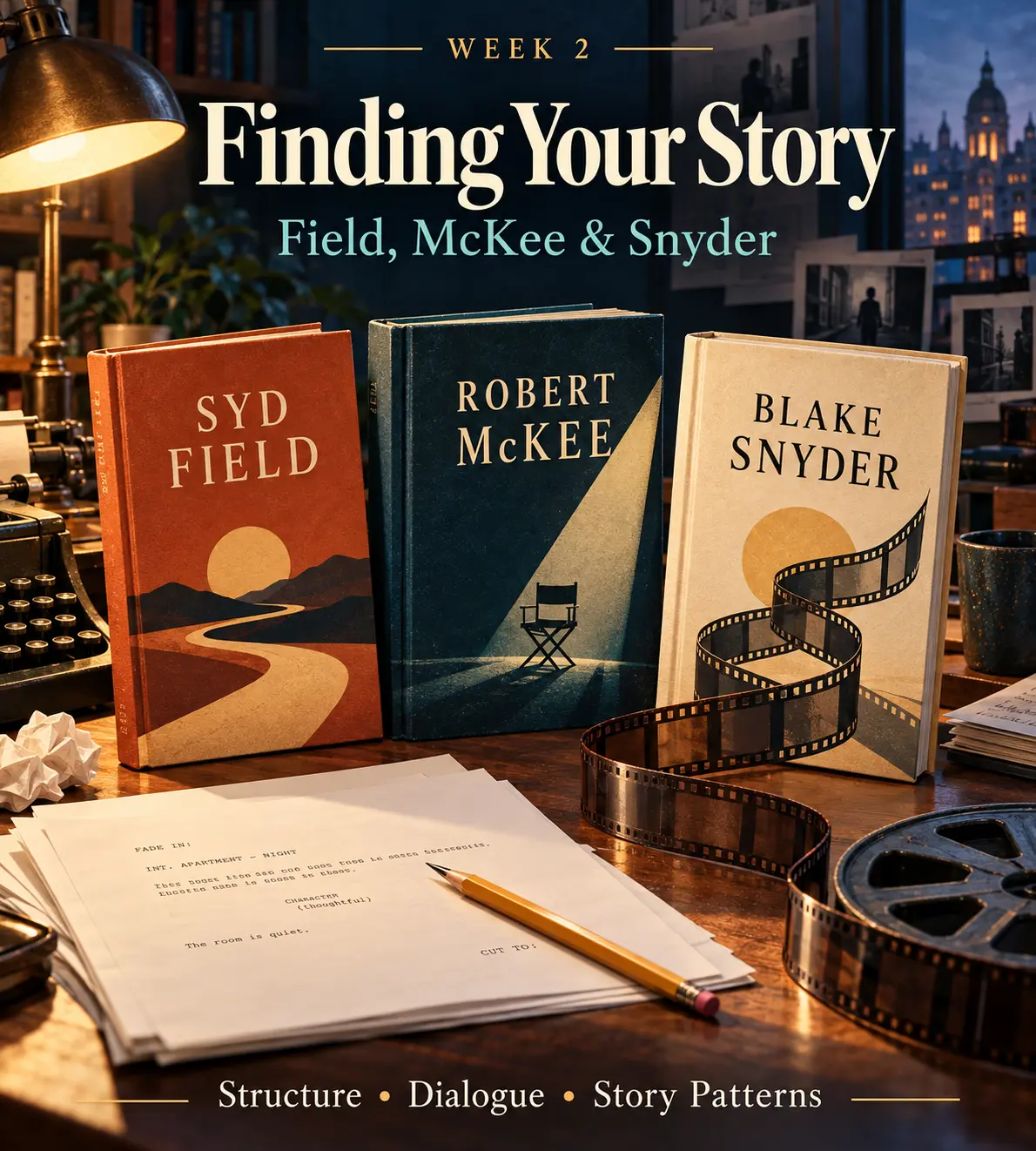
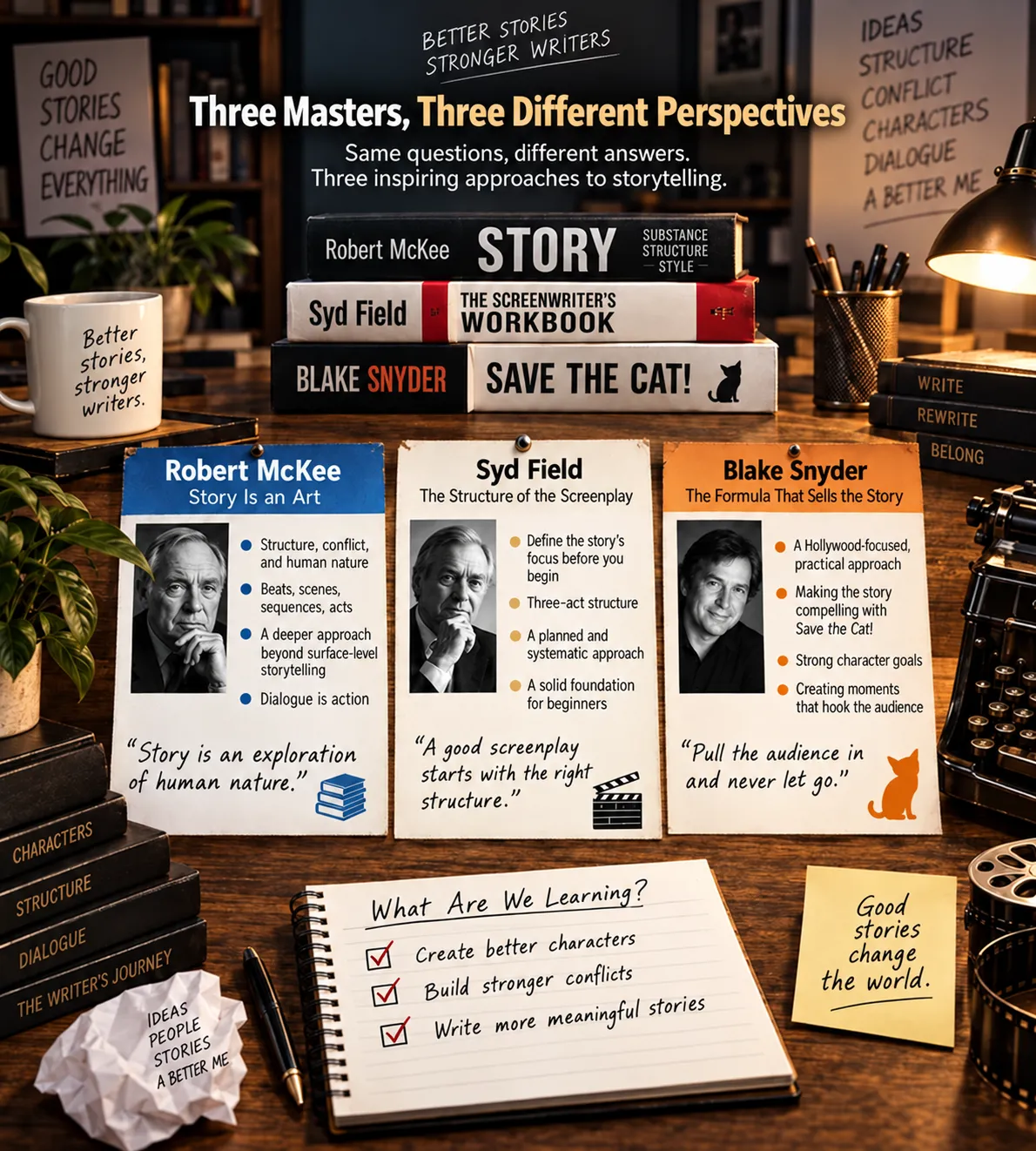
If you ever want to feel like you are losing your mind, try reading three books written by the same guy simultaneously. I am completely convinced Syd Field only wrote one book, changed the covers and titles and made three times the money.
Syd Field’s Screenwriting Books: Repetition, Metaphors, and Structure
This week, the man literally copy-pasted his own analogies across Screenplay, The Workbook and the Problem Solver. I had to read about a chess game and its pieces “completing each other” three separate times. Then came the glass metaphor “you can put anything in a glass and it keeps it together”. By the time he hit me with the table analog “a table can be circular, tall or short, but it is a flat surface with four legs” I genuinely had to check if I was reading the same book again. Field isn’t just repetitive like I thought last week, he is recycling material across his bibliography in real time.
The absolute peak of his madness was in The Problem Solver, where he takes a six-page intermission just to tell me the entire plot of The Shawshank Redemption. Six pages! I am reading a book on how to solve script problems and Syd is just eating popcorn and giving me a scene-by-scene recap of Andy whatshisname.
How Field Uses Metaphors to Explain Screenplay Structure
Now, as much as I wanted to throw these books out the window, I won’t sit here and say that the metaphors are for nothing. He is running a structural boot camp. By hammering me over the head with tables, glassware and Shawshank. He is forcing me to understand that before I can write a single line of brilliant, soul-searching McKee dialogue, I need a rigid container to put it in.
Is Reading Three Syd Field Books Worth It?
I have to give Syd Field a bit of grace here. He is, at his core, a classic teacher. And you know how teachers are, they find three analogies that work in a classroom, memorize them and repeat them until the end of time. If it isn’t broke don’t fix it. But from a critical standpoint, what Field is doing across these three books is blatant textual recycling. He is treating his own writing like boilerplate content, copying and pasting the same canned rhetoric about chess pieces and glassware. It the ultimate literary rehash. Still, if you want to actually read Syd Fields books, I suggest buying one of these books and reading it three times.
Robert McKee’s Story and Dialogue: Structure with Greater Flexibility
Reading McKee this week felt like getting actual answers instead of repetitive homework.
Archplot, Miniplot, and Antiplot: McKee’s Three Story Designs
In story this week, he talks about the structure spectrum. He doesn’t force you into a one size fits all box. Instead, he explains storytelling choices through the structure spectrum. He breaks it down into three distinct designs: Archplot (classical structure with external conflict and linear time), Miniplot (minimalism focused on internal changes and open endings), and Antiplot (antistructure that uses coincidence and absurdity).
Syd Field vs. Robert McKee: Formula and Narrative Flexibility
This was thankfully a massive contrast to Field. While Field is telling me act one must be exactly 30 pages long, McKee is showing me that structure is a flexible spectrum based on the specific type of story you want to tell. He gives you options and explains the logic behind different narrative forms, rather than handing you a rigid formula and expecting you to just follow it. I think we can all agree storytelling and screenwriting require creativity and Fields rules take away from that necessary creativity which is why reading McKee this week felt like a breath of fresh air.
The Three Functions of Dialogue: Exposition, Characterization, and Action
In dialogue McKee lays out three things speech must simultaneously do in a script. If your dialogue isn’t executing these three functions at the same time its just filler. Exposition; it has to advance the plot and reveal necessary information, but it must feel natural rather than a forced data dump. Characterization; every line must reveal who the character is showing their specific background, attitude and personality. Action; dialogue is verbal action. A character only speaks because they want something from someone else and their words must actively move the scene forward.
I did realize McKee also repeated some things but instead of giving the same exact examples he actually expanded on the things he mentioned in the first episodes. This week he showed me how to handle structure and speech with actual depth. While field is giving you a rigid container, McKee is the one teaching you how to actually create what goes inside it.
Blake Snyder’s Save the Cat!: Understanding Movie Genres and Story Patterns
And now Snyder, news flash “the fast-talking, hyper-capitalistic Hollywood agent surprisingly turns out to be an amazing guy to talk about movies with. Moving up in the ranks, he actually managed to charm his way out of my doghouse this week.
Going into week two, I expected to completely hate Snyder’s second chapter, which is literally titled “give me the same thing… only different!”. It sounds like the same assembly line movie machine as last week. But reading through it, my opinion completely shifted. It felt a lot less capitalistic and repulsive than last week. In fact, it was incredibly fun and made me actually watch some of the old classical movies I hadn’t seen in a while.
Why Snyder Looks Beyond Comedy and Drama
Snyder argues that traditional genres like “comedy” or “drama” are too broad to be useful for a writer. Instead, he invents his own ten hyper-specific categories to classify every story ever told. He throws out an amazing list of movie examples to back up his theories, breaking things down into categories like Monster in the House (which connects Jaws to Alien), Golden Fleece (heist and road trip movies), or Dude with a Problem. (Die Hard).
How Comparable Films Help Writers Understand Story Patterns
Instead of feeling like a cold corporate checklist, his breakdown actually feels like a passionate study of story patterns. By showing how drastically different movies share the exact same structural DNA, he proves that studying your “comps” (comparable films) isn’t about plagiarizing, it’s about understanding the core human appeal of a specific type of story.
If week one Snyder felt like a corporate sellout, week two Snyder felt like a guy who just really loves cinema and knows how to break it down. His categories are genuinely amazing and practical. He isn’t replacing the high art of McKee; he is just giving me a fantastic, highly entertaining map of how the movies we love actually fit together.
Week 2 Verdict: What Field, McKee, and Snyder Offer Screenwriters
Here is my second week verdict. Syd field took a major hit. Reading his three books at the exact same time did him absolutely no favors. The blatant textual recycling and copy pasted metaphors made it feel less like learning and more like a repetitive hustle.
Robert McKee benefited the most. Unlike fields echo chamber, McKees two books fit together beautifully, like puzzle pieces. What he states in one book directly supports and expands upon the other, proving his theories have deep, cohesive structural integrity. Blake Snyder found his true purpose. After a rough first week, Blake won me over because his practical approach clicked into place. Blake isn’t necessarily teaching you the deep art of how to write the story, McKee is doing that. Blake’s job is the help you figure out how to sell the story you’ve just learned how to write.